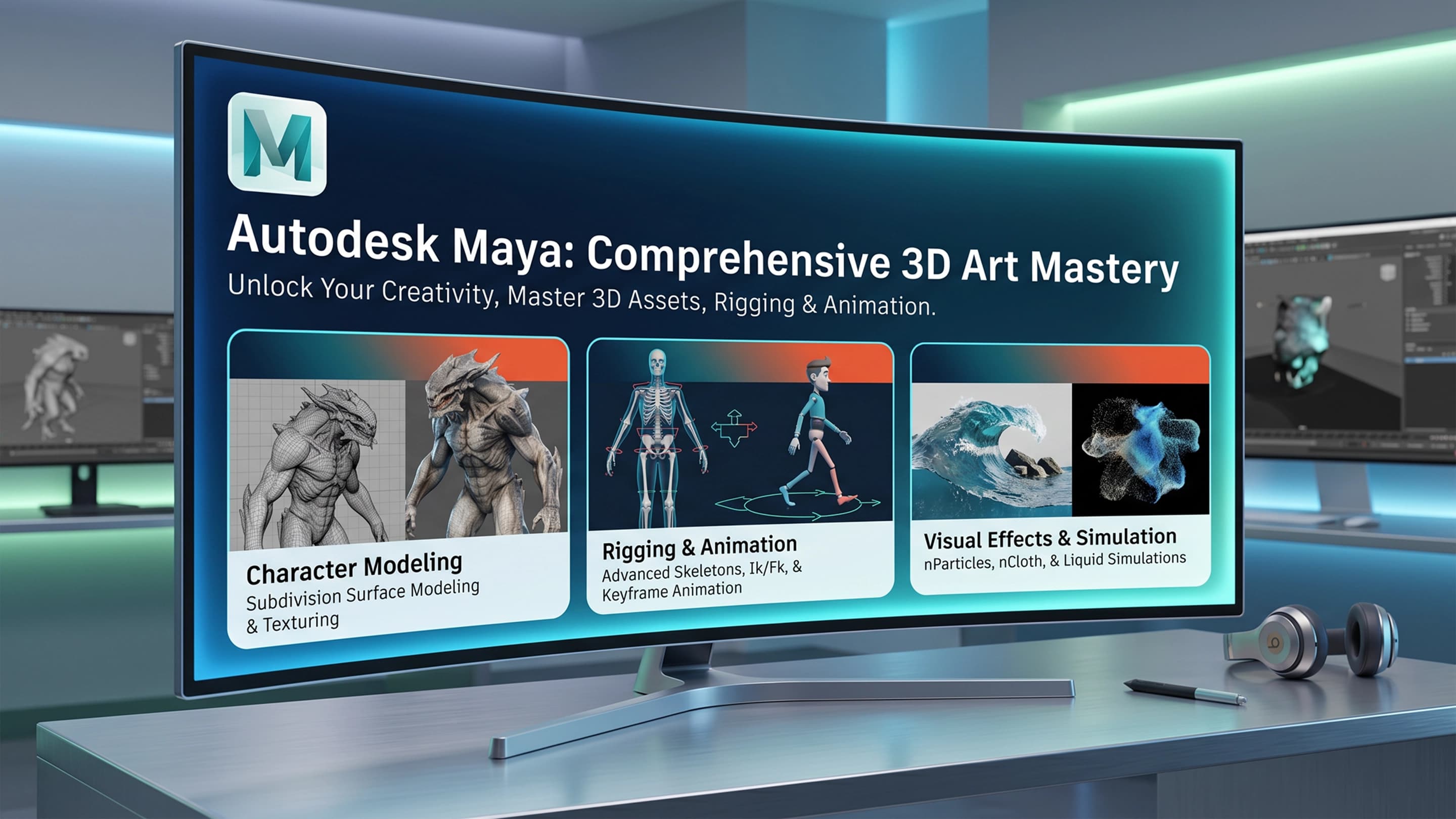
Master 3D Assets, Character Rigging, & Cinematic Animation Architecture Course
Interested in this course?
Register your interest or send an enquiry for curriculum details and upcoming batches.
In today's elite digital entertainment ecosystem, 3D Creation in Autodesk Maya has progressed past isolated modeling tasks into an interconnected discipline centered on pipeline integration, automated data transfer, and high-fidelity performance engineering. An exceptionally detailed digital character model is fundamentally useless if its facial topology collapses under extreme expressions, or if its file dependencies stall a multi-seat studio render farm. This highly technical curriculum is explicitly designed to shift your creation methods away from superficial artistic guess-work toward engineering living, high-throughput asset assets that move seamlessly into production pipelines.
Elite production studios require technical directors and animators who can maintain complete creative control over performance arcs while navigating rigid data handoff constraints. This course completely bypasses elementary navigation tutorials, anchoring your training inside authentic studio operational footprints. You will learn to construct complex visual assets, script customized automation layouts with Python 3, and deploy scalable asset nodes matching the strict technical infrastructure definitions practiced by the world's most dominant game development and cinematic VFX studios.
Course Content
The geometric, physical, and architectural core of this program trains you to execute advanced 3D assets completely from scratch:
The Mathematics of Vector Topology: Structuring flawless edge-loop flow, vanishing points, and quad distribution to prevent texture stretching and skinning tearing.
Advanced Surface Tension Visualizations: Deploying Dynamic Geometry Attributes nodes (
dgaTension,dgaDelta) to map and analyze surface deformations as real-time viewport heat maps.Kinetic Crowds & Environment Population: Harnessing integrated Golaem systems to procedurally distribute, control, and animate thousands of digital assets or characters across dense environments simultaneously.
Cinematic Camera Sequencer Operations: Managing focal lengths, sensor profiles, lens distortion parameters, and context-driven shot structures connected directly with Flow Production Tracking tools.
Advanced Arnold Render Architecture: Configuring multi-pass light paths, setting up production-safe GPU/CPU render tiles, and applying image-to-image machine learning models for noise elimination.
Syllabus
This studio-aligned training track guides you systematically from raw polygonal manipulation through to high-fidelity character orchestration and automated scene rendering:
Module 1: Advanced Polygonal Topology, Volume Booleans, & Cloud Retopology: Crafting advanced hard-surface configurations, manipulating organic geometry via Volume Boolean nodes, and utilizing cloud-based Flow Retopology.
Module 2: Advanced Look Development, MaterialX, & LookdevX Nodes: Creating cross-renderer shading networks, implementing MaterialX color spaces, and configuring the native open-source OpenPBR default surface shader.
Module 3: Kinematic Skeletal Frameworks, Weight Painting, & Skinning: Aligning structural joint chains, painting high-precision weights across multi-layer skin clusters, and constructing flexible IK/FK systems.
Module 4: Machine Learning Rig Optimization & Structural Deformers: Training custom ML Deformer nodes, analyzing surface tension heat maps, and automating localized procedural wrinkles.
Module 5: Dynamic Motion Paths, Graph Splines, & Time Sliders: Editing subtle spatial interpolation fields, designing color-coded Graph Editor channel sets, and optimizing viewport caching systems.
Module 6: Procedural Bifrost FX, OpenUSD Scenes, & Render Delivery: Designing node-based fluid and destruction physics graphs, managing large OpenUSD scene assemblies, and executing final Arnold pass packaging.
Career Scope & Opportunities
The unending scale of immersive video game engines, epic episodic streaming media, and cinematic content platforms has created high-paying pathways for master Maya technical artists:
3D Character Rigging Engineer / Technical Director: Creating and maintaining the complex computational bone and skin deformer frameworks that animators utilize to give characters life.
AAA Character / Environment Modeler: Engineering structurally perfect, highly optimized hard-surface and organic models optimized for massive rendering setups and game asset compilation.
Senior 3D Character Animator: Scripting organic human emotions, explosive action sequences, and high-precision physical interactions for elite cinematic releases.
Procedural VFX & Simulation Technical Director: Creating complex procedural weather, destruction, liquid environments, and physics systems via Bifrost node structures.
OpenUSD Pipeline Architect: Designing structural database handoffs, controlling global asset metadata, and syncing cross-platform tool workflows between Maya, Unreal Engine, and Houdini.
Market Demand
The commercial immersion of an animation pipeline dictates its global viewing metrics and asset value. If an asset stretches incorrectly, if a character's expression registers as wooden, or if background elements feel static and disconnected, consumer immersion shatters immediately—costing production studios millions in lost capitalization. Simple consumer tools and automated AI prompt engines produce flat, non-deformable geometric shapes that fail under professional rendering pipelines, meaning world-class entertainment houses remain completely dependent on expert Maya technicians. Tech organizations and animation pipelines globally are expanding interactive production budgets, actively looking for human designers who understand advanced technical constraints.
Skills to Gain
By graduating from this master program, you control elite, high-margin asset engineering capabilities that convert instantly into market value:
Absolute 3D Pipeline Autonomy: Full operational authority over deep node-based material architectures, complex machine-learning deformation configurations, and fluid simulations.
Hyper-Velocity Animation Iteration: The capability to compress production validation times by utilizing automated viewport caching workflows, enabling real-time frame evaluation without creating heavy playblasts.
Studio-Standard Pipeline Engineering: The ability to engineer universal, lightweight files using clean OpenUSD parameters that read cleanly into modern composition networks and real-time game engines.
Strategic Computational Problem Solving: The spatial confidence to debug complex mesh-tearing and tracking errors during asset reviews, verified by explicit physical and volumetric mathematical proofs.
Scalable Independent Consultant Viability: Mastering Python script integration, advanced character rigging configurations, and procedural effects automation, allowing you to secure premium contract fees globally.
Note on Versioning Trajectories: Specific plugin modules, simulation engines, and portfolio capstone guidelines adapt continuously to align directly with live Autodesk developer enhancements and studio reference guidelines. As industry career advisors, we systematically study modern entertainment trends to align your structural 3D training with the exact division of the global entertainment economy you want to dominate.
What you will learn
- Sub-D & Hard Surface Production Modeling
- Bi-Pedal & Creature Character Rigging
- Frontier Machine Learning Deformations
- Cinematic Pacing & Graph Editor Mastery
- Node-Based FX & Bifrost Simulation Engineering
- Enterprise LookDevX & OpenUSD Pipeline Ops
Interested in this course?
Register your interest or send an enquiry for curriculum details and upcoming batches.