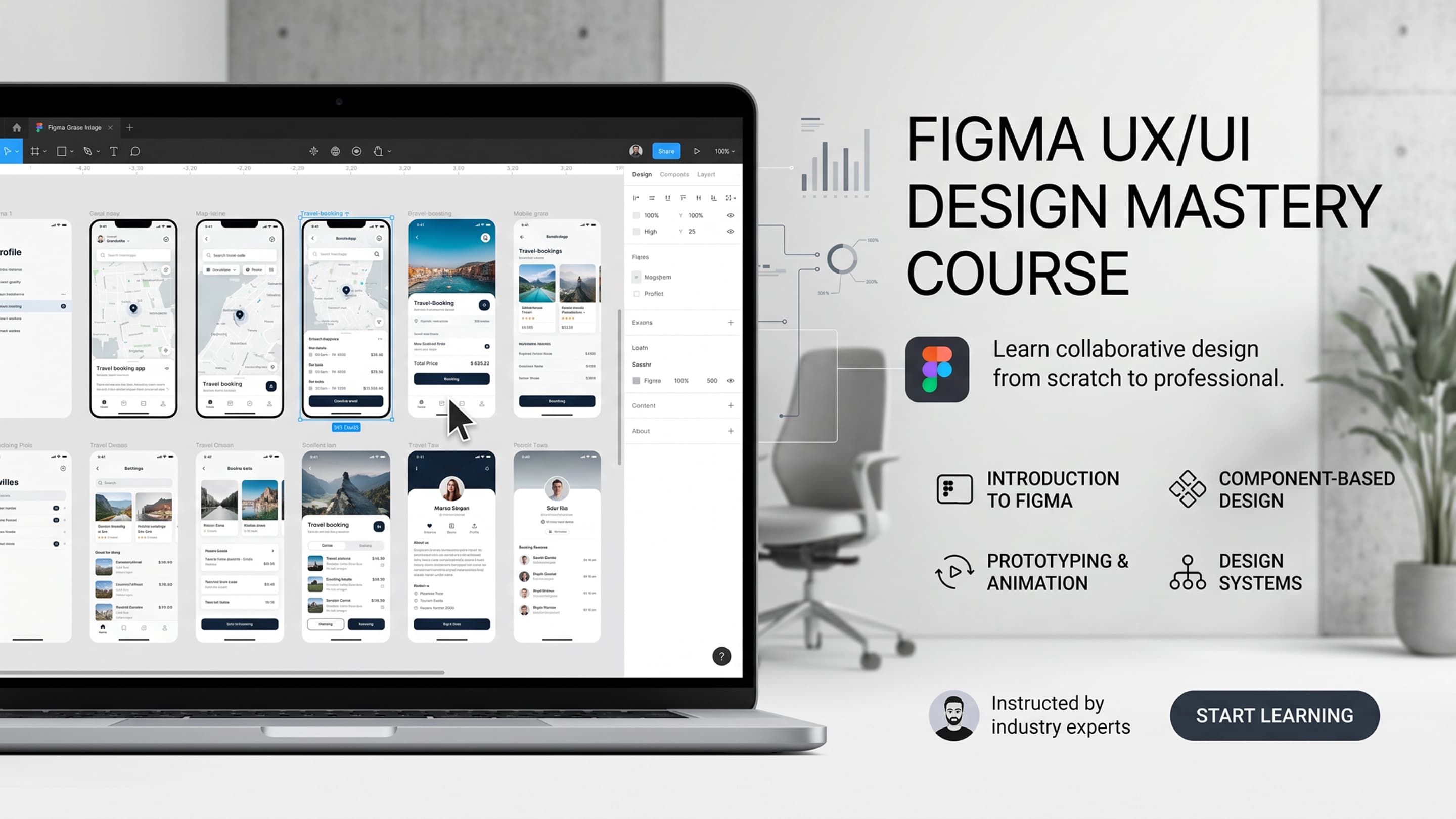
Master UI/UX Product Design & Scalable Figma Systems Engineering Course
Interested in this course?
Register your interest or send an enquiry for curriculum details and upcoming batches.
In today's highly dynamic tech ecosystem, UI/UX Design in Figma has transcended basic flat screen layouts to become a rigorous, system-level architecture framework focusing on design-to-code alignment, dynamic context tokens, and AI-integrated design operations. A pretty layout means nothing if it falls apart under live customization or fails to account for edge-case content states. This exhaustive, enterprise-aligned curriculum is systematically crafted to fundamentally transition your workflow from drawing isolated vector graphics to deploying living, scalable design systems that smoothly integrate with engineering pipelines.
Modern product teams demand UX/UI designers who can visualize complex user flows, test behavioral theories via advanced interactive wireframes, and hand off clean, pixel-perfect structural files that require zero guesswork from developers. This course strips away superficial tutorial steps and trains you inside production-grade workflow environments. You will learn to architect accessible, dark mode-ready layouts and establish strict variable behaviors matching the rigid delivery standards of global tech giants, ensuring you can scale an enterprise product from initial user flow directly to automated shipment.
Course Content
The technical, interactive, and structural backbone of this program teaches you how to construct comprehensive digital applications from scratch:
The Logic of Semantic Tokenizing: Mapping abstract brand definitions to intent-based tokens (e.g., mapping
color-button-primary-backgroundrather than a raw hexadecimal value) to allow easy machine readability and platform-wide theme switching.Fluid Viewport Breakpoint Mechanics: Constructing multi-device screen grids that gracefully morph across standard mobile screens, tablet displays, web interfaces, and dense SaaS dashboard metrics.
Advanced Component Property Structures: Minimizing layout file weight by utilizing text parameters, instance swapping tools, and conditional visibility switches within single master components.
Behavioral Prototyping & Feedback Pacing: Crafting empathetic error states, smart loading skeletons, and interactive modal screens that systematically lower cognitive user load and increase platform trust.
Enterprise Asset Handoff Documentation: Managing component state files, writing technical UX guidelines inside files, structuring version control logs, and managing team workspace environments.
Syllabus
This enterprise-ready design track guides you step-by-step from core vector manipulation to advanced full-stack design system architecture:
Module 1: Vector Mechanics, Workspace Logic, & Canvas Typography: Customizing workspace preference layers, mastering baseline grid alignments, configuring typographic hierarchies, and managing vector layout elements.
Module 2: Responsive Auto Layout Systems & Box Architecture: Deep-diving into padding configurations, alignment behaviors, min/max dimension constraints, wrap settings, and nested layout rules.
Module 3: Modular Components, Variant Matrices, & Slot Architecture: Building structural master blocks, establishing variant property parameters, wiring multi-state interactive toggles, and managing shared team libraries.
Module 4: Advanced Variable Trees, Themes, & Mode Swapping: Configuring multi-mode variables, mapping tokens for automatic light-to-dark theme transitions, and implementing localized spacing matrices.
Module 5: Dynamic Interaction Logic & Behavioral Prototyping: Wiring screen connection paths, configuring trigger events, injecting conditional formula variables into prototypes, and testing responsive flow instances.
Module 6: Developer Production Handoff, Dev Mode, & AI Integration: Organizing handoff files, exporting code specs, configuring asset packaging workflows, and formatting layers for automated design-to-code plugins.
Career Scope & Opportunities
The endless transition of global services into multi-device application platforms has generated immense market value for design architects capable of engineering systemized user environments:
Lead Product Designer (UI/UX): Architecting user journeys, translating business goals into sleek digital interfaces, and coordinating design features with core software engineering leads.
Design Systems Engineer / Operator: Creating and maintaining enterprise-wide centralized component libraries, governing variable tokens, and optimizing design-to-development file tooling.
Interaction & Motion Designer: Constructing highly immersive visual micro-interactions, responsive dashboard widgets, and functional animations to improve system utility scores.
UX Researcher & Information Architect: Executing user testing loops, translating analytical metrics into structural app layouts, and auditing accessibility guidelines.
Freelance Design Studio Contractor: Running a premium software design consultancy to deliver production-ready Figma UI kits, web landing systems, and interactive app prototypes to global tech clients.
Market Demand
An organization's software usability directly governs its retention metrics and operational scalability. In an era where users are heavily distracted and possess minimal patience for confusing navigation, unoptimized applications with messy layouts are instantly uninstalled, triggering millions in lost business transactions. Because basic, automated templates produce generic, cookie-cutter screens that fall apart during customization, the global tech industry relies completely on human product designers who understand deep human behavior and systematic consistency. Global enterprises are massively scaling their design operations budgets, actively seeking specialists who can construct robust, systemized, and accessible visual frameworks from the ground up.
Skills to Gain
By graduating from this program, you command high-margin, professional design capabilities that translate directly into direct career trajectory optimization:
Absolute Design System Autonomy: Total technical control over variable design sets, responsive auto layouts, complex component states, and large-scale asset sync libraries.
Hyper-Velocity Prototype Iteration: The capability to compress product validation cycles from weeks into hours by assembling production-matched interactive frameworks that behave like real applications.
Production-Grade File Architecture: The skill required to produce perfectly structured, semantically named, and clean Figma files that integrate seamlessly into modern developer setups without confusion.
Strategic Product Articulation: The professional confidence to pitch and defend user-experience decisions to executive product stakeholders backed by usability parameters and performance data.
Scalable Independent Viability: Mastering modern framework plugins, team management spaces, and token-to-code file workflows, empowering you to command top-tier pricing for standalone global interface contracts.
Note on Evolutionary Trajectories: Specific plugin selections, design methodologies, and project capstone goals adapt continuously to mirror frontier software tech trends. As educational consultants, we systematically analyze core learning frameworks to tightly align your product design training with the exact sub-sector of the digital economy you intend to build.
What you will learn
- Advanced Variable Architecture & Tokenization
- Fluid Fluidity with Auto Layout
- Component Component Systems & Variant Matrices
- High-Fidelity Prototyping & Functional Motion
- AI-Legible Design Structures & Multi-Modal Frameworks
- Advanced Cross-Functional Developer Handoff
Interested in this course?
Register your interest or send an enquiry for curriculum details and upcoming batches.