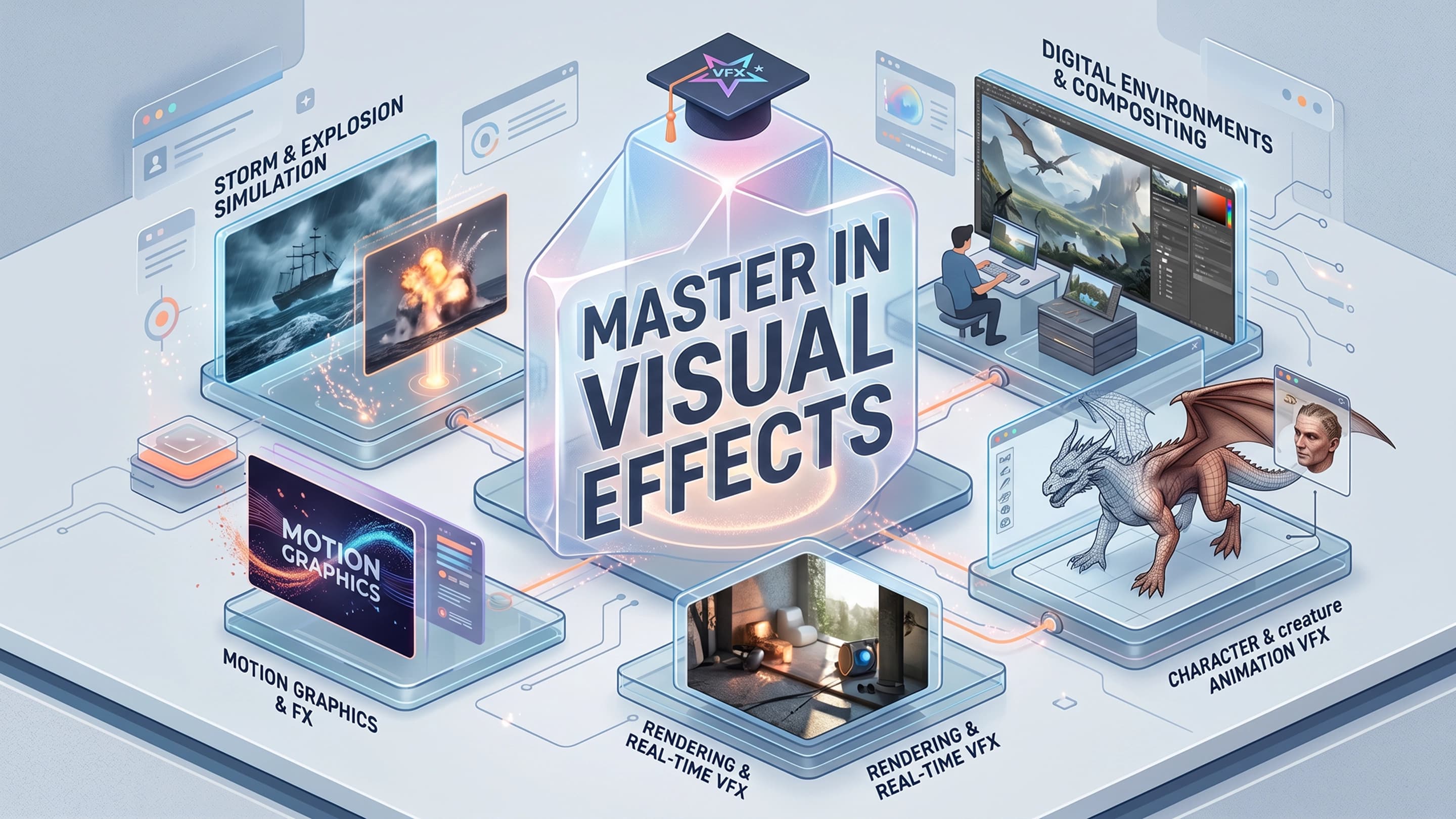
Master Visual Effects & Advanced Node-Based Compositing Systems Engineering Course
Interested in this course?
Register your interest or send an enquiry for curriculum details and upcoming batches.
In the modern cinematic ecosystem, Visual Effects Compositing is the ultimate structural bridge where photography, 3D computer graphics, and color science merge into a single reality. The compositor is the final gatekeeper of an image; every asset generated by modeling, animation, and simulation departments must pass through your node tree to become believable. This comprehensive, production-mapped curriculum is engineered to completely restructure your visual execution, moving you past basic software filters into system-level, pixel-perfect image manipulation.
High-end post-production houses require artists who can naturally blend real world elements with impossible digital creations under razor-thin shipping windows. This course strips away superficial hobbyist tricks and immerses you directly within an authentic pipeline framework. You will work with uncompressed, high-dynamic-range image sequences (OpenEXR), master advanced color spaces (ACES), and script automated workflow assets to meet the rigorous scale and quality standards of premium episodic television and blockbuster feature film studios.
Course Content
The technical, optical, and logistical core of this program teaches you how to construct cinematic shots from the ground up:
The Physics of Light & Optics: Analyzing lens distortion maps, light wraps, falloff matrices, and depth-of-field anomalies to mimic real camera behavior perfectly.
Advanced Color Space Science: Implementing the Academy Color Encoding System (ACES) pipeline to ensure uniform color fidelity from the raw camera sensor directly through final theatrical projection.
Digital Grain De-noising & Regraining: Stripping out physical sensor noise to perform smooth tracking and masking operations, followed by sampling and restoring matching grain profiles to synthetic additions.
Spatial Tracking & Planar Deformation: Utilizing point and planar tracking matrices to seamlessly pin graphics, scars, or digital set extensions onto moving or curving surfaces.
Script Optimization & Python Tooling: Writing brief terminal scripts and expressions to manipulate multiple node networks simultaneously, create custom automated write paths, and speed up render times.
Syllabus
This studio-ready training track guides you step-by-step from fundamental image processing to master-level multi-pass VFX completion:
Module 1: Node Mechanics, Read/Write Infrastructure, & Color Spaces: Navigating the node graph workspace, understanding channel management (RGBA), configuring ACES color management, and setting up clean project dependencies.
Module 2: Advanced Extraction, Core Keying, & Edge Refinement: Isolating subjects from backdrops, deploying custom Keylight/Primatte workflows, creating custom garbage masks, and reconstructing fine edge selections.
Module 3: Rotoscoping, Tracking Controls, & Digital Plate Prep: Drawing high-speed organic motion shapes, parenting shapes to tracking data vectors, painting out rigging wires, and generating clean background plates.
Module 4: 3D Camera Tracking, Matchmoving, & Set Extensions: Reconstructing complex real-world camera paths, generating precise point clouds, placing 3D projection cards, and extending physical set environments.
Module 5: Multi-Pass CG Compositing & Deep Data Architecture: Merging multi-pass OpenEXR render layers, adjusting individual light group parameters, balancing diffuse and ambient reflections, and navigating deep image streams.
Module 6: Pipeline Automation, Python Scripting, & Master Delivery: Building reusable gizmos, scripting automated write nodes, troubleshooting render bottlenecks, and exporting clean, studio-compliant final composites.
Career Scope & Opportunities
The endless scaling of global streaming networks, cinematic universes, and high-fidelity video game cinematics has generated historic demand for technical compositing artists:
Digital Compositor (VFX Artist): The essential core position at major visual effects facilities, assembling live-action plates with complex computer-generated elements.
Matchmove / Tracking Specialist: Tracking camera paths and object vectors precisely, forming the indispensable spatial base that all upstream departments rely upon.
Roto & Paint Artist / Digital Prep Lead: Performing clean-plating, wire removal, and matte generation routines—the vital baseline discipline that launches elite VFX careers.
Technical Director (VFX Pipeline TD): Developing custom Python automation tools, maintaining studio asset databases, and streamlining render farm integration.
Bespoke VFX Studio Consultant: Operating an elite independent visual effects boutique to deliver premium clean-ups, commercial beauty work, and digital set extensions to global corporate clients.
Market Demand
An audience's immersion depends entirely on the photorealistic believability of a shot. If a shadow drops slightly wrong, a digital asset lacks lens blur, or a green screen edge glows unnaturally, the illusion breaks instantly, wasting millions in production capital. Simple, automated AI background removers or consumer-grade video filters produce soft, unconvincing edges that fall apart on cinema screens—leaving studios completely dependent on skilled human compositors. Leading entertainment companies worldwide are scaling post-production investments, actively searching for technicians who can confidently assemble complex visual assets with mathematical and artistic precision.
Skills to Gain
By graduating from this program, you command high-margin, professional capabilities that translate directly into top-tier studio placements:
Absolute Node Environment Autonomy: Complete technical control over complex node networks, multi-channel configurations, spatial tracking setups, and final image calculations.
Hyper-Velocity Shot Iteration: The capability to rapidly adjust massive compositing networks by altering parameters early in the node tree, updating version assets instantly without destroying downstream work.
Production-Grade File Engineering: The capability to manage multi-pass OpenEXR sequences cleanly, ensuring data integrity, minimal script bloat, and flawless handoffs to studio review systems.
Strategic Visual Articulation: The professional confidence to analyze and break down complex visual errors during daily reviews, backed by solid optical principles and color data proofs.
Scalable Independent Viability: Mastering Python workflow integrations, custom automation tools, and standard delivery specifications, allowing you to command top-tier rates for remote global commercial work.
Note on Pipeline Evolution: Specific software versions, external plugin integrations, and portfolio shot milestones update continuously to adapt to the VFX Reference Platform and evolving studio standards. As career advisors, we thoroughly evaluate modern industry workflows to align your digital compositing training with the exact sector of the entertainment economy you intend to capture.
What you will learn
- Advanced Node Graph Architecture
- Multi-Pass CG Integration & AOV Separation
- Deep Image Compositing Workflows
- Chroma Keying & Spill Suppression
- Precision Photorealistic Matchmoving
- Industrial Rotoscoping & Invisible VFX
Interested in this course?
Register your interest or send an enquiry for curriculum details and upcoming batches.